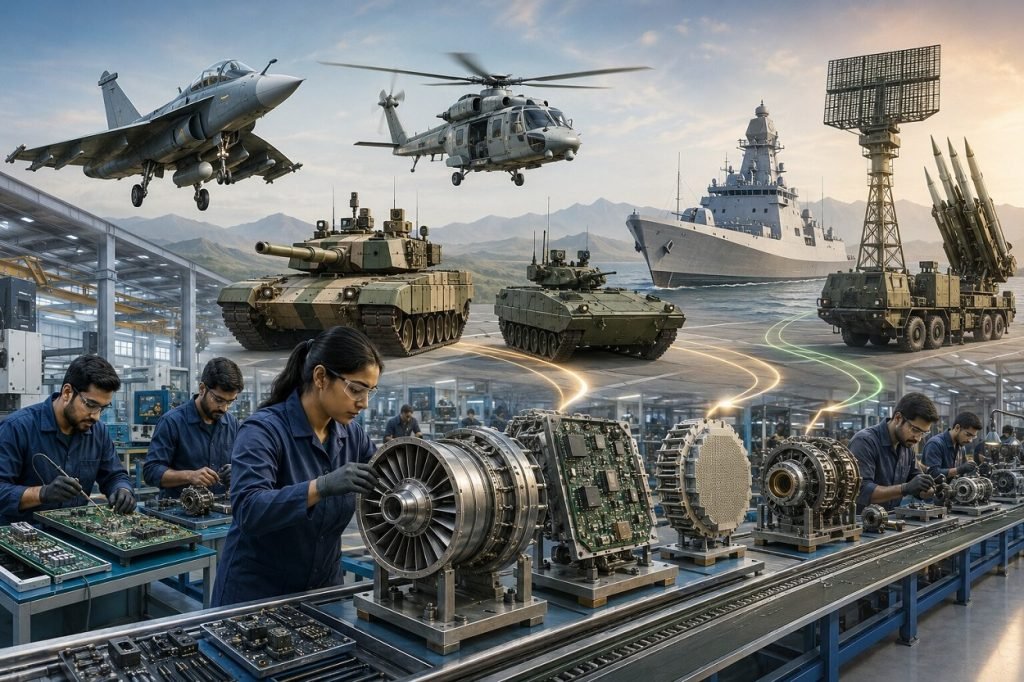
India’s defence and industrial policy landscape has shifted fundamentally over the past five years. The Atmanirbhar Bharat initiative, the successive positive indigenisation lists from the Ministry of Defence, the strategic partnership framework and the expanded iDEX programme have collectively created a market environment where domestic sourcing is not merely preferred but is, for an increasing range of components, mandatory. For OEMs and system integrators specifying circular connectors and cable harness assemblies, navigating this environment requires understanding both the policy mechanics and the practical supply chain implications.
The Policy Framework in Plain Terms
The Ministry of Defence has published multiple positive indigenisation lists covering hundreds of component categories. An item on these lists may be procured from foreign sources only until the notified transition date, after which it must be sourced domestically from a qualified Indian manufacturer. The lists are cumulative — categories are added, not removed — and the transition from foreign to domestic sourcing is expected to be accompanied by technology transfer, qualification investment and supply chain development by Indian industry.
For connectors, several circular and rectangular military connector categories have appeared on these lists, and the direction of policy is clearly toward expanding coverage. OEMs who have not already begun developing qualified domestic connector sources are behind the curve and risk programme disruptions when import restrictions take effect.
What Qualifies as Domestic Content
The defence procurement rules define domestic content with some precision, and the details matter for OEMs calculating their compliance position. Domestically manufactured goods must meet a minimum domestic value addition threshold, which means that a product assembled in India from imported components may not satisfy the domestic content requirement. For connectors, genuine domestic manufacture — design, machining, plating and assembly in India — clearly satisfies the requirement. A trading company that imports finished connectors and repackages them does not.
This distinction drives the practical advice to build supply relationships with manufacturers who make the product themselves. A certificate of origin from a genuine manufacturer, supported by audit evidence of the manufacturing process, is straightforward to provide and verifiable. A claimed domestic origin that cannot be substantiated by factory audit creates compliance risk for the OEM.
Cable Harness as a Domestication Opportunity
For OEMs sourcing complete cable harness assembly india for defence programmes, the indigenisation requirement extends to the harness, not just the connectors within it. A harness built in India using domestic connectors, domestic wire and domestic accessories satisfies the domestic content requirement far more completely than one built abroad using imported components. The Indian harness manufacturing sector has developed the capability to meet this requirement, and OEMs who consolidate their harness sourcing to domestic specialists gain both policy compliance and supply chain simplification.
European-Origin Equipment and VG Connector Indigenisation
A particular complexity arises for OEMs whose platforms incorporate European-origin equipment specified with VG-family connectors. The VG connectors used in German-standard circular connector families were, until recently, available domestically only in limited quantities. The indigenisation push has accelerated domestic qualification of VG 95234 ranges, and Indian manufacturers now supply these families with Ministry of Defence qualification documentation. For programmes involving Euopean-specification platforms, the ability to source VG-family connectors domestically removes a significant supply chain vulnerability and supports the indigenisation compliance position.
Technology Transfer and Capability Development
The positive indigenisation list framework creates both an obligation and an opportunity for technology transfer from foreign connector manufacturers to Indian partners. Several global connector manufacturers have entered technology transfer agreements with Indian companies in response to these policy signals, enabling domestic production of connector families that were previously available only as imports. OEMs should understand which of their connector specifications are covered by such arrangements and what qualification status the domestic licensee has achieved, because a technology transfer agreement that has not resulted in a qualified product is not a supply chain solution.
Practical Steps for OEMs
The practical steps for an OEM navigating connector indigenisation begin with an audit of the connector types used across the product portfolio, mapped against the positive indigenisation list categories and the transition dates that apply. For each connector type, the audit identifies whether a qualified domestic source exists, what the lead time and qualification status of that source is, and what tooling or specification changes would be required to transition from the current foreign source.
For connector types where no qualified domestic source yet exists, early engagement with a capable domestic manufacturer to begin the qualification process is essential. Qualification takes time — typically one to three years for a new connector family through defence approval channels — and OEMs who start this process only when the policy deadline arrives will face a gap. Established connector manufacturers in India including Allied Electronics Corporation, which already hold Ministry of Defence qualifications across multiple circular connector families, are natural partners for OEMs mapping this transition.
Conclusion
India’s indigenisation policy is transforming the connector supply chain from a procurement convenience into a strategic imperative. OEMs who treat this as a compliance exercise will find themselves managing crises as transition deadlines arrive. Those who treat it as a supply chain development opportunity, building deep relationships with qualified domestic manufacturers across their connector portfolio, will build supply chain resilience that benefits programme delivery, cost and technical performance simultaneously. The transition is manageable for any programme that starts it in time.